Engineer
The Engineer looks at the plan, explains which pieces are needed and gives one step at a time.
Skills supported
- Giving information
- Sequencing
- Describing
- Checking understanding
- Sharing an idea through another person
Program One
Build Together. Communicate Together. Grow Together.
Solongo Brick-Based Therapy is a structured, play-based small-group program that uses collaborative building to create natural opportunities for children to communicate, cooperate and solve problems with peers.
Children work towards one shared goal. The focus is not on creating a perfect model — it is on participation, communication, teamwork and shared achievement.
Why it's different
In an ordinary building activity, children may work beside one another.
In Solongo Brick-Based Therapy, they need one another.
Children work toward one shared goal. Each child holds a different part of the information, materials or task, creating natural reasons to request, listen, explain, wait and solve problems together.
The goal is not a perfect model.
The goal is meaningful participation, communication and teamwork.
How it works
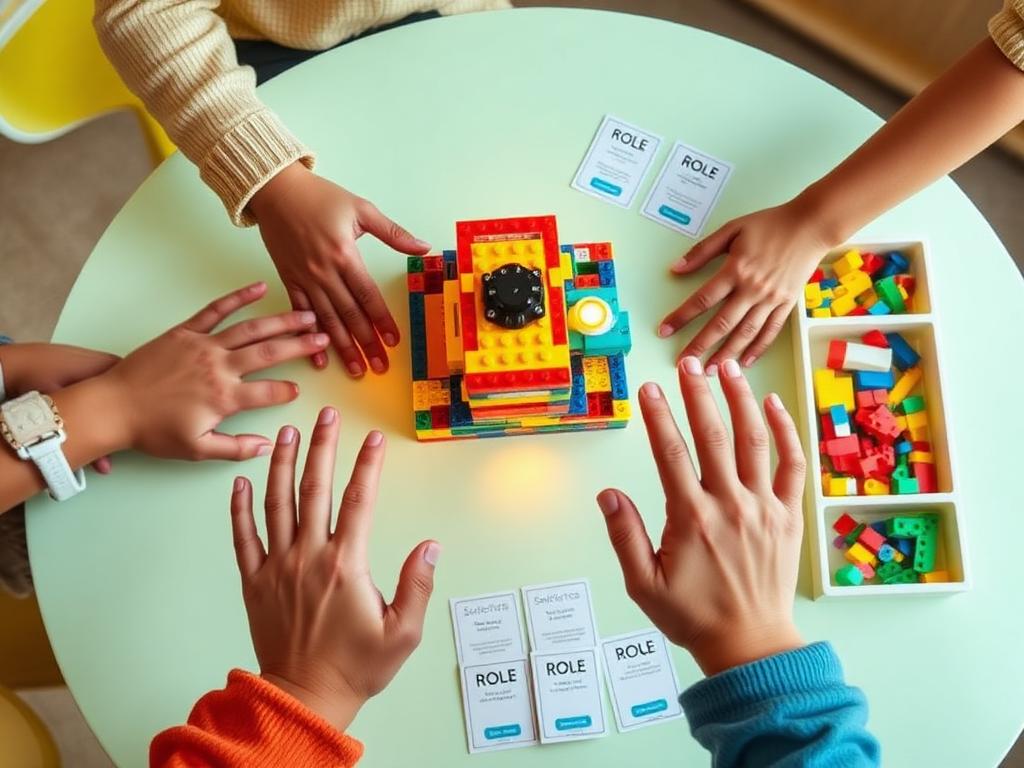
The group uses three clear roles so that every child contributes something the team needs.
The Engineer looks at the plan, explains which pieces are needed and gives one step at a time.
Skills supported
The Supplier listens to requests, finds the correct pieces and provides them to the Builder.
Skills supported
The Builder follows the instructions, assembles the model and tells the team when something is unclear or does not fit.
Skills supported
Roles are rotated with support so that children can practise different ways of communicating and contributing.
Technology with a purpose
Traditional large-format building blocks support creativity, structure and shared play.
AI Seed adds a functional technology layer.
Children can create visible signals and immediate outcomes.
Children learn that an intentional action can control what happens next.
Shared models can move, creating real reasons to test and improve.
Models can respond when an object approaches or the environment changes.
Children begin to predict input and output, notice cause and effect, and troubleshoot as a team.
The technology is not there to replace social interaction.
It creates new concept for children to communicate, cooperate and solve problems together.
Developmental focus
Requesting, explaining, responding, clarifying and asking for help.
Turn-taking, sharing materials, joint attention and contributing to a shared goal.
Planning, following steps, remembering roles, changing strategies and completing tasks.
Waiting, handling mistakes, requesting a break, accepting support and returning to the activity.
Spatial thinking, mechanical understanding, creativity, logic, technology confidence and pride in contribution.
Every session has one primary developmental focus, while the other areas are naturally supported through the shared activity.
The pilot program
Build a shared rover and activate its navigation light.
Primary focus: Social communication
Create one shared ocean model with a glowing feature.
Primary focus: Social interaction
Use a button to control a light and follow a clear sequence.
Primary focus: Executive function
Use a motor, take turns and manage unexpected results.
Primary focus: Emotional regulation
Predict how a sensor will activate movement.
Primary focus: Strengths and future capability
Combine a button-controlled gate and sensor-triggered warning light in one final team challenge.
Primary focus: Integrated five-domain practice
Step by step
Children use visual supports to understand the session and communicate readiness.
The group receives one shared building and technology challenge.
Each child becomes Engineer, Supplier or Builder.
The team constructs the model and adds the AI Seed technology.
Children predict, test, experience mistakes and work together to improve the system.
The group identifies what worked, what was difficult and what each child contributed.
Suitability
The program may suit children who:
Participation is based on individual suitability and group matching, not diagnosis alone.
Interests in building, systems and technology are not gender-specific. Solongo Brick-Based Therapy is open to children of all genders whose interests and support needs match the program.
Our commitment
Solongo Brick-Based Therapy does not aim to make children appear less autistic or force one "correct" style of communication. The program:
A child's strong interest is not something to remove.
It may be the bridge that helps them participate, contribute and connect.
The most advanced part of Solongo Brick-Based Therapy is not simply the motor, sensor or light. It is the way five elements work together:
Structured Collaborative Roles
Functional Technology Projects
Five Development Domains
Professional Early Intervention Guidance
Meaningful Parent Feedback
Interest becomes participation.
Participation becomes communication.
Communication becomes collaboration.
Collaboration grows into confidence and future capability.
Program note: Solongo Brick-Based Therapy is a structured, evidence-informed, play-based program. It is not a cure for autism and does not replace individualised assessment, speech pathology, occupational therapy, psychology or other professional supports where these are required.